Vertex Transcribe Service
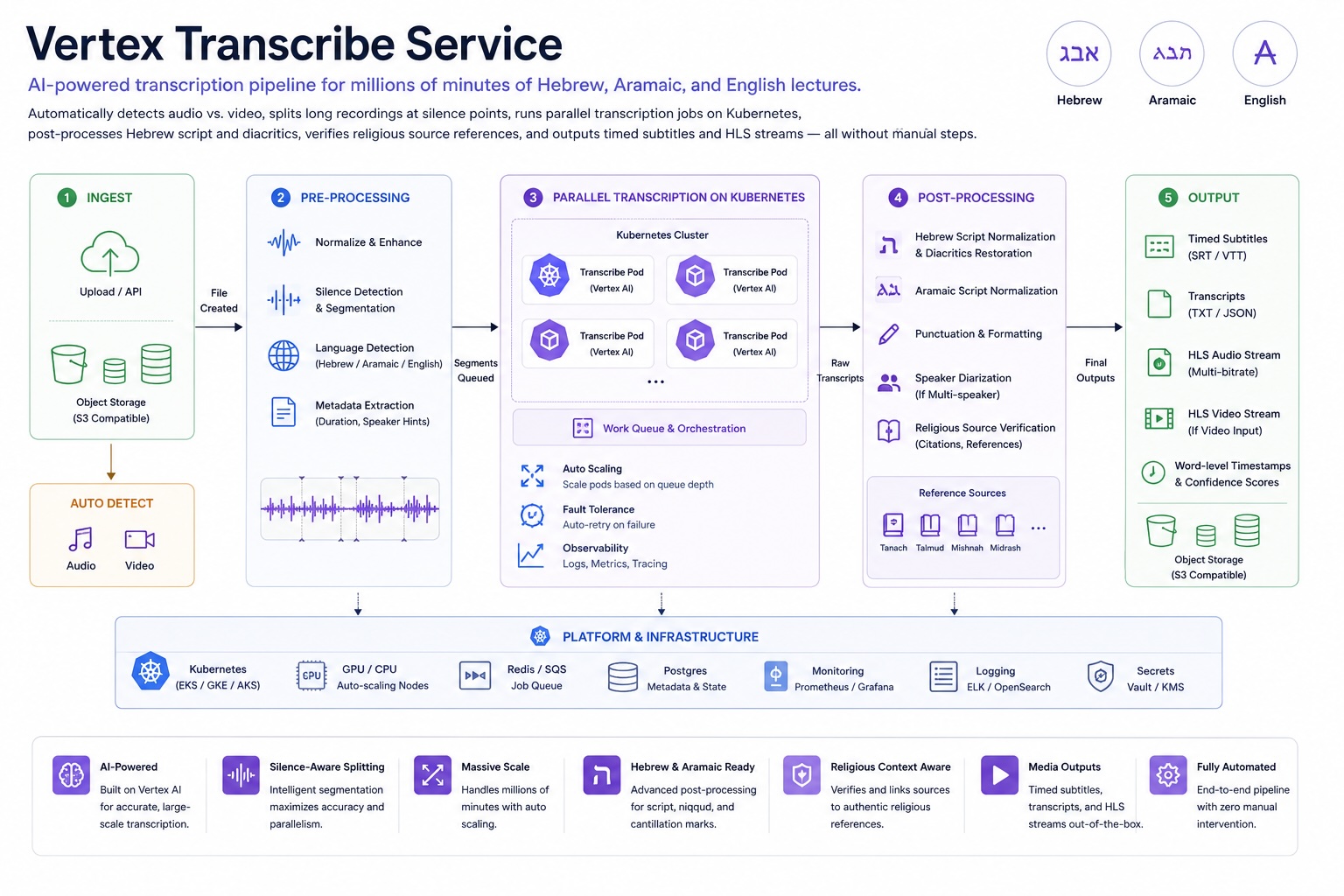
An AI-powered transcription pipeline built to handle millions of minutes of Hebrew, Aramaic, and English educational lectures. The service automatically detects audio vs. video, splits long recordings at silence points, runs parallel transcription jobs on Kubernetes, post-processes Hebrew script and diacritics, verifies religious source references, and outputs timed subtitles and HLS streams — all without manual steps.
Challenges
Mixed-language audio in a single recording
Lectures frequently switch between Hebrew, Aramaic, and English mid-sentence. We needed multi-step AI prompting and post-processing to handle script conversion, diacritics, and language-specific formatting without one language corrupting another.
Splitting long recordings without losing continuity
Many lectures exceed one hour. Sending them to the AI in one shot would exceed context and rate limits. We split files at natural silence points using FFprobe, transcribed each chunk independently, then stitched timestamps back together without gaps or overlaps.
Scale and API rate limits under batch load
Running 300+ concurrent jobs means hitting AI API rate limits hard. We implemented adaptive backoff, queue management, and per-job retry logic to keep throughput high without triggering provider-side throttling or losing jobs silently.
Cost control across three model tiers
Gemini Pro, Flash, and Flash-Lite have very different cost and quality profiles. We built routing logic that selects the right model based on content length and complexity — cutting API costs by up to 60% without measurable accuracy loss on shorter content.
Our approach
Ingest and detect
Every incoming file goes through FFprobe to determine whether it is audio or video and to measure duration and format. Video files have their audio track extracted automatically. Files longer than 20 minutes are queued for silence-based splitting.
Chunk and transcribe in parallel
Audio is split at natural silence points into chunks. Each chunk is sent to the selected Gemini model with a structured schema that forces timestamped, speaker-labeled output. Chunks run in parallel — the model tier is chosen per file based on length and budget.
Merge, post-process, and verify
Chunks are stitched back into a continuous timeline with corrected offsets. The merged text goes through Hebrew script conversion, diacritics restoration, formatting cleanup, and religious citation verification against an external database.
Video processing in parallel
While transcription runs, a separate pipeline handles HLS conversion at multiple bitrates and resolutions, thumbnail generation, preview clip creation, and multi-track audio processing.
Deliver to cloud storage
Transcription, timed subtitles, automatic summary, and HLS streams are uploaded to cloud storage with secure delivery links. The content team receives a notification when the job is complete.
Result
99% transcription accuracy. 300+ concurrent jobs. Up to 60% lower AI API costs through dynamic model selection. Built to scale to millions of minutes.
By the numbers
99%
Transcription accuracy
300+
Concurrent jobs
up to 60%
API cost reduction via model selection
99%
Subtitle timestamp accuracy
Tech stack

We want to hear your thoughts.
our CTO Kyrylo Osadchuk, will reply within 24 hours. No SDR funnel.
Start a conversation
We want to hear your thoughts
Re: Vertex Transcribe Service